



Beads for tissue homogenization
Tissue homogenization balls enable quick and effective fragmentation of tested samples, which is why the method of tissue disintegration using balls is increasingly used in laboratories. There are available many types of balls made of materials of various hardness and density, which give many possibilities to choose the most appropriate balls to obtain the desired fragmentation of the tested sample.

Yttrium-stabilized zirconium oxide beads for tissue homogenization
Yttrium-stabilized zirconium oxide balls are ideal for biological material disintegration because:
– they are very hard (above 9 on the Mohs scale)
– they are heavy (specific gravity 6.0 g/cm3)
– they are resistant to chemicals (they withstand, for example, rinsing with acid to remove contamination with organic material)
– they have a perfectly smooth surface
– they do not absorb any liquids
– they are extremely resistant to abrasion (they do not contaminate samples)
Yttrium-stabilized zirconium oxide balls they are slightly lighter and much harder than steel balls, and also available in very small diameters, which allows for more precise fragmentation of the material. They are the only ceramic balls produced in sizes below 0,5 mm (the smallest size is 0,1 mm). Thanks to the large number of available diameters (especially small ones) and the accuracy of their manufacture, it is possible to precisely select the diameter in order to obtain the intended fragmentation of the tested material.
Properties and other applications areas of yttrium stabilized zirconium oxide balls are presented here.

Steel balls for tissue homogenization
For hard samples, can be applied, for example, chrome steel balls with a diameter of approx. 3 mm (steel balls are heavier, but less hard than ceramic balls).
Specific gravity: ok. 7,85 g/cm³
Properties and other applications areas of steel balls are presented here.
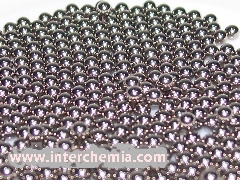
Glass beads
Glass beads have been used in laboratories for years. They proved useful for homogenization of soft samples.
Specific gravity: 2,5 g/cm³
Wide range of available diameters, for example:
0,4-0,6 mm; 0,8-1,0 mm; 1,0-1,3 mm; 2,0-2,3 mm; 2,9- 3,3 mm
Packing: 25 kg
Properties and other applications areas of glass balls are presented here.
